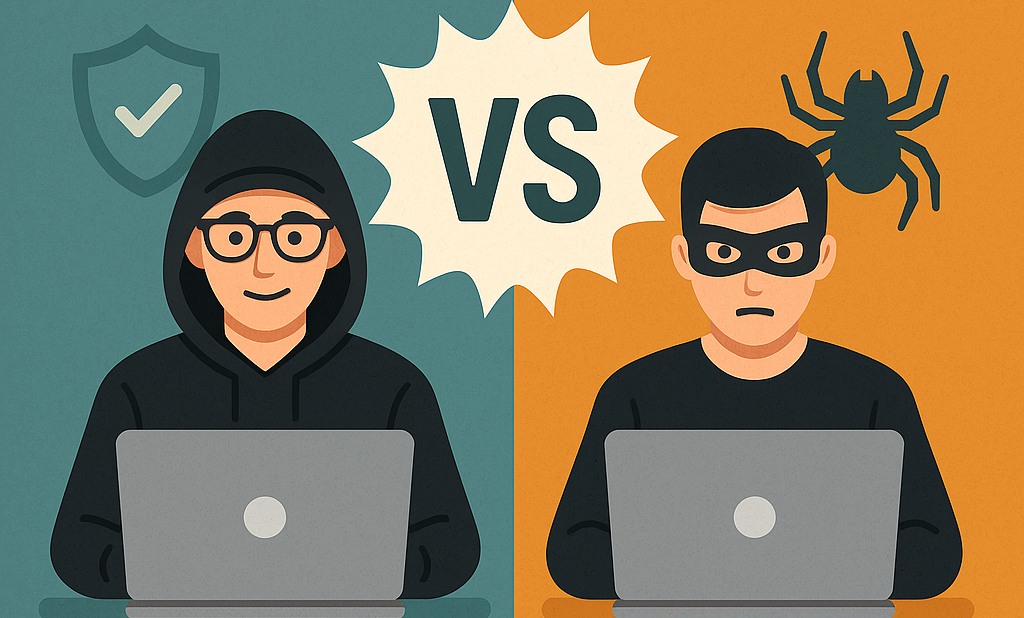
Ever wondered how companies figure out if their digital fortresses are strong enough? They don’t just hope for the best! They hire specialized digital detectives to put their defenses to the test. You’ve probably heard terms like “ethical hacking” and “penetration testing,” and while they sound similar, they’re not quite the same.
Think of it like being a doctor for a house. Sometimes you do a general check-up, looking at everything. Other times, you focus intently on one specific wall that might have a crack.
In the world of cybersecurity, understanding the difference between ethical hacking and penetration testing is key to knowing how digital defenses are built and secured. Let’s break down these two vital practices.
Understanding Ethical Hacking: The Broader Art of Digital Investigation
Ethical Hacking is the big picture, the overarching philosophy. It’s the practice of using the same tools, techniques, and mindsets as malicious hackers, but with explicit permission and for a good cause: to identify vulnerabilities and improve security. An ethical hacker acts like a digital detective, exploring every nook and cranny of a system to discover potential weaknesses.
Imagine an ethical hacker as a curious and skilled mechanic. They might take apart an entire car engine, not to damage it, but to understand every component, see how it works, find potential flaws, and suggest ways to make it run better or prevent future breakdowns.
Key Characteristics of Ethical Hacking:
- Broad Scope: Ethical hacking often involves a wider range of activities. It can include vulnerability assessments, social engineering attempts (with consent), web application security testing, wireless network analysis, and more. It’s about finding any way in or any weakness.
- Creative & Exploratory: Ethical hackers are encouraged to be creative and think outside the box. They use diverse methods, sometimes combining different techniques, to discover new or complex vulnerabilities. Their goal is often to simulate real-world attackers who don’t follow a strict checklist.
- Tool Agnostic (Often): While they use tools, ethical hackers prioritize the mindset and knowledge. They understand why a tool works and can often achieve results manually or even develop their own tools.
- Continuous Process: For many organizations, ethical hacking is an ongoing practice, integrated into their security lifecycle to constantly adapt to new threats and evolving systems.
- Goal: To comprehensively identify and understand all possible security weaknesses and risks within a system or organization.
Demystifying Penetration Testing: The Targeted Security Drill
Penetration Testing (Pentesting) is a specific type of ethical hacking. It’s a more targeted and structured simulation of a real-world attack against a specific system, application, or network to identify exploitable vulnerabilities. The goal is to determine if a vulnerability can actually be exploited, what impact that would have, and how far an attacker could get.
Think of penetration testing as a highly specialized military drill focused on a specific objective. The drill leader might say, “Your mission is to get into the King’s treasure room through the south wall, and then report what you find.” The team then uses all their skills, but only to achieve that specific, defined goal.
Key Characteristics of Penetration Testing:
- Narrower, Defined Scope: A pentest has a very clear, pre-defined scope. For example, “Test the login page of our e-commerce website,” or “Attempt to gain access to our internal HR database from an external network.” The boundaries are strict.
- Time-Bound: Pentests usually have a specific start and end date. They are projects with clear deliverables.
- Objective-Driven: The primary objective is to prove whether a specific weakness can be successfully exploited and to what extent, often simulating a specific attack scenario. It’s less about finding every flaw and more about proving the impact of known or suspected flaws.
- Reporting Focus: A crucial outcome of a pentest is a detailed report outlining the vulnerabilities found, how they were exploited, the potential business impact, and recommendations for remediation.
- Types: Pentests can be “black box” (the testers have no prior knowledge of the system, like a real attacker), “white box” (testers have full knowledge, like an internal employee), or “grey box” (a mix).
The Crucial Differences: Scope, Goal, and Depth
While both practices use similar techniques and aim to improve security, their core distinctions lie in:
- Scope:
- Ethical Hacking: Broad. “Find all the security weaknesses, wherever they may be.”
- Penetration Testing: Specific. “Can you get into this specific system through these defined methods?”
- Goal:
- Ethical Hacking: Comprehensive discovery of all vulnerabilities and risks.
- Penetration Testing: Prove exploitability and measure the impact of specific vulnerabilities against a defined target.
- Depth vs. Breadth:
- Ethical hacking often provides breadth, covering many areas to uncover a wide range of potential issues.
- Penetration testing provides depth, diving deep into a specific target to fully understand the chain of exploitation and its consequences.
You can think of it this way: All penetration testing is a form of ethical hacking, but not all ethical hacking is penetration testing. Ethical hacking is the larger umbrella, and penetration testing is a specialized service or method under that umbrella.
| Feature | Ethical Hacking | Penetration Testing |
| Scope | Broad (entire IT infrastructure) | Narrow (specific targets) |
| Frequency | Ongoing/continuous | Periodic or scheduled |
| Objective | Identify and fix vulnerabilities early | Simulate attacks to test defenses |
| Methods Used | Wide range, including human factor tests | Structured attack scenarios |
| Reporting | Detailed analysis + improvement plan | Technical report on test findings |
Why Both Are Essential for Digital Defense
Both ethical hacking and penetration testing are indispensable tools in a robust cybersecurity strategy.
- An organization might first engage in general ethical hacking activities (like vulnerability assessments and continuous monitoring) to discover a wide array of potential weaknesses across its entire digital footprint.
- Once a critical system or a newly discovered vulnerability needs a deeper, more focused examination, they would commission a penetration test to simulate a targeted attack and understand the true exploitability and impact.
For aspiring cybersecurity professionals, understanding both concepts is crucial. Whether you’re interested in the broad exploration of an ethical hacker or the laser-focused mission of a penetration tester, both paths lead to becoming a vital defender in our increasingly digital world. You’re learning how to be a digital detective, ready to protect those who rely on technology every day!
Frequently Asked Questions (FAQ)
Q: Do I need to be an ethical hacker to become a penetration tester?
A: Yes, generally. Penetration testing requires all the skills and knowledge of an ethical hacker, but applied in a more structured and targeted way. Ethical hacking provides the foundational mindset and techniques.
Q: Which one is more in demand for jobs?
A: Both are highly in demand! Many job titles will use “Penetration Tester” or “Pentester” because it’s a very specific service. However, the skills you learn as an ethical hacker are fundamental to many roles, including security analysts, incident responders, and security consultants.
Q: Is “vulnerability scanning” the same as a penetration test?
A: No.
- Vulnerability Scanning: An automated tool that scans systems for known vulnerabilities. It’s like a quick health check that flags potential issues. It tells you what might be wrong.
- Penetration Test: A manual (though tool-assisted) process where a human expert tries to exploit those vulnerabilities. It tells you if and how a real attacker could get in.
Q: Can I do ethical hacking or penetration testing on any system?
A: Absolutely not! You must have explicit, written permission from the owner of the system or network before you attempt any form of ethical hacking or penetration testing. Without permission, it is illegal and can lead to severe legal consequences. Always practice in a controlled “home lab” environment or on platforms specifically designed for ethical hacking practice (like TryHackMe or Hack The Box).
Q: What certifications are good for these fields?
A: For ethical hacking, certifications like CompTIA CySA+ (Cybersecurity Analyst+) or CEH (Certified Ethical Hacker) are common starting points. For penetration testing, the OSCP (Offensive Security Certified Professional) is widely regarded as a challenging and highly respected practical certification.
Leave a Reply